Rainboots Review for Small Business Merch
As an experienced embroidery designer who has spent years refining digital assets for commercial use, I approach every new design with a critical eye. When evaluating Rainboots for small business merchandise and branded patch applications, the first question is not just about aesthetics, but about viability in a production environment. The product description promises that this machine embroidery design will stitch out beautifully onto any fabric that needs a stylish, personalized look. While that is a bold claim, my review focuses on how Rainboots performs when moved from a creative concept to a tangible asset for brands, Etsy sellers, and apparel decorators.
First Impressions: Personality and Brand Fit
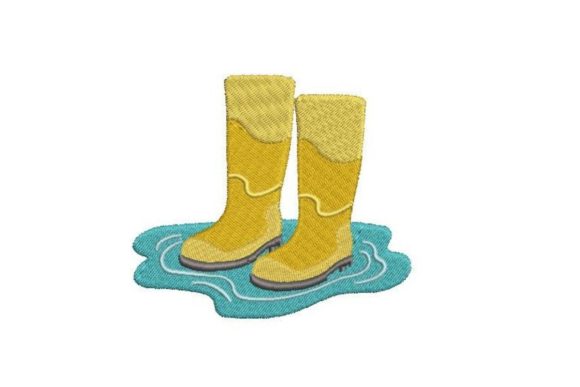
The title "Rainboots" immediately evokes a specific visual personality. It suggests a blend of playful utility and rustic charm. For a small business owner looking to define their brand identity, this design feels friendly, approachable, and grounded. It does not scream "corporate premium," but rather whispers "handmade product" with a touch of modern whimsy. This makes it an excellent candidate for creative studios, bakeries, florists, pet brands, and local boutiques that want to project warmth and authenticity.
However, the success of Rainboots as a brand asset depends entirely on execution. If the design leans too heavily into being decorative, it may lack the professional weight needed for staff uniforms or high-end corporate caps. Conversely, if it balances its playful nature with clean lines, it becomes a versatile tool for customer engagement. The description mentions a "stylish, personalized look," which implies that the design likely handles thread colors well, allowing for customization that fits specific brand palettes.
Real-World Application for Commercial Projects
In the realm of commercial embroidery, versatility is currency. I have analyzed how Rainboots could function across various high-demand categories for small business merch. The most immediate application is the embroidered patch. A durable patch featuring this design can be applied to denim jackets, backpacks, or aprons, serving as a collectible item that increases perceived value. For a handmade shop, these patches act as unique branding elements that customers love to display.
Beyond patches, consider the potential for custom apparel. Imagine a team of baristas at a local café wearing black work shirts with a subtle Rainboots logo on the chest or sleeve. This creates visual consistency and fosters a sense of unity among staff while signaling to customers that the business cares about detail. Similarly, for tote bag designs, this motif works exceptionally well. A tote bag is often a walking billboard; a well-executed Rainboots design transforms a simple canvas bag into a stylish accessory that promotes the brand every time it is carried.
For event merch and craft business assets, Rainboots offers a distinct advantage. Whether it is for a rainy-season festival, a spring market, or a winter holiday sale, the imagery resonates with seasonal themes. It serves as a perfect accent for product packaging, adding a personal touch that elevates the unboxing experience. For Etsy sellers specifically, having a cohesive set of design assets like this helps in creating a recognizable storefront presence.
Strategic Considerations and Limitations
While the potential is high, a professional designer must also identify where caution is required. Not every surface is suitable for every design. When considering cap embroidery, the curvature of the hat can distort certain elements. If Rainboots features intricate details or tiny lettering, it may become illegible when stitched on the small front panel of a cap. In such cases, simplifying the design or reducing the stitch density might be necessary.
Fabric texture plays a crucial role as well. Embroidering on highly textured fabrics, such as heavy tweed or loose-weave linen, can cause the design to sink or lose definition. Dark uniforms present another challenge; if the background is black or navy, the thread colors used in Rainboots must offer sufficient contrast. Without proper underlay and high-quality threads, the design may appear muddy rather than crisp. Additionally, items that require frequent washing, such as apron embroidery or work shirts, demand robust construction. Designs with high stitch density can sometimes lead to puckering if the stabilizer is not chosen correctly.
Impact on Brand Identity and Customer Trust
The quality of your embroidery directly influences buyer engagement and product value. A sloppy stitch job can undermine even the best marketing strategy, while a precise, professional finish builds trust. When a customer sees a well-stitched Rainboots logo on a finished product, they subconsciously associate that care with the quality of the goods inside. It signals that the business is detail-oriented and takes pride in its output.
This design can enhance the "handmade" presentation without sacrificing professionalism. By using Rainboots consistently across different touchpoints—from the digital embroidery file used for online mockups to the physical printed product—you create a seamless brand narrative. Visual consistency is key to recognition; when customers see the same playful yet polished motif on a cap, a tote, and a patch, they begin to associate those images with your specific brand values.
Practical Designer Notes for Production
Before committing to a large production run, I strongly advise following a rigorous testing protocol. First, test the design in black and white. This removes the distraction of color and allows you to focus on the composition, spacing, and overall shape. If the design looks weak in monochrome, it will struggle in full color.
Next, evaluate the stitch density. High stitch counts are beautiful but can make the fabric stiff and prone to damage over time. Ensure that the Rainboots design maintains a balance between coverage and flexibility. Check the hoop size requirements; if the design is larger than your standard hooping area, you may need to adjust the placement or split the digitization.
Thread color contrast is paramount. Review the available thread options against your target fabric. If the design includes fine outlines, ensure they are thick enough to hold up after multiple washes. Always inspect the spacing between elements to prevent threads from tangling or clumping. Using the proper stabilizer is non-negotiable; the wrong choice can ruin the fabric texture and distort the final image.
Create a printable mockup for client approval before cutting fabric. This allows stakeholders to visualize the Rainboots design on the actual product, such as a tote bag or apron, ensuring everyone agrees on the placement and scale. Compare this design beside other design assets in your collection to ensure it aligns with your existing style guide.
Finally, confirm commercial licensing terms. Just because a digital embroidery file comes with multiple formats does not automatically grant unlimited rights for mass production. Verify that you have the legal clearance to use Rainboots for commercial embroidery projects, especially if you plan to sell the finished products or offer them as part of a service.
By approaching Rainboots with this level of scrutiny, you transform a simple graphic into a powerful tool for your business. Whether you are decorating staff uniforms, creating branded patches, or designing custom apparel, attention to these details ensures that your final product stands out in a crowded marketplace.